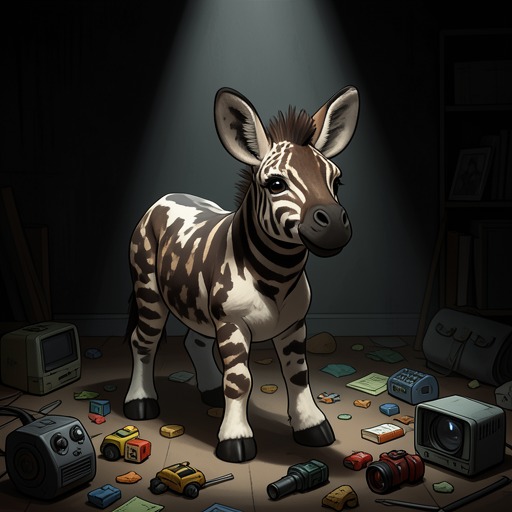
Woodland Park Zoo Zebra-Slider Souvenir Pen
The Art of Racing in the RainThe Woodland Park Zoo Zebra-Slider Souvenir Pen turns a modest novelty into a pivotal object in Enzo’s understanding of the zebra motif. Its tiny image moves across a plastic savannah when the pen is tipped; in Enzo’s reading, that motion makes visible the destructive impulse he believes is approaching Denny as he considers signing papers concerning his daughter. The pen does not speak or act beyond its simple mechanism, but its image gives Enzo a concrete warning—and prompts him, despite age and injury, to intervene.
Appearance and First Notice
Denny holds up the pen during a conversation with Mike. After Denny has described his distress about an operation and its lasting physical consequences, he shifts attention to the souvenir and remarks on it. Mike identifies its source as Woodland Park Zoo. Enzo looks more closely: inside the transparent plastic top is a little savannah, and, when Denny tips the pen, a zebra slides across it. The object’s effect depends on an ordinary physical action. It is not a static picture but a small scene that changes position in the holder’s hand.
That movement matters because the zebra is already charged with meaning for Enzo. During a period of solitude, roughly forty hours into it, he believes he may be hallucinating and sees Zoë’s stuffed zebra moving and behaving as if alive. Later, faced with disorder in Zoë’s room, Enzo assumes the zebra has caused it. Denny instead blames Enzo, and Eve protects him. Enzo’s explanation at the time is a frightened interpretation, not reliable confirmation that the toy acted on its own. The pen’s sliding image recalls that earlier episode while inviting a different account of what the zebra represents.
The Zebra as an Inner Threat
Seeing the figure move across the miniature landscape, Enzo recognizes the zebra not as an external demon but as something within people: their fears and capacity for self-destruction in times of crisis. This is the object’s central narrative function. Its toy-sized landscape reduces the earlier uncanny image to a mechanical illustration, yet that smallness sharpens Enzo’s insight. What had seemed to him a hostile creature outside himself can instead be understood as a name for the impulses that arise inside a person under pressure.
The pen does not establish that Enzo’s interpretation is an objective fact about Denny’s state of mind. It stages Enzo’s recognition and shows how strongly he believes that the zebra image applies to the decision before them. As Denny brings the pen toward the paper, Enzo watches the slider inch toward the signature line. He interprets the approaching zebra as the force behind the possible signature, and reasons that Denny would not willingly give up his daughter merely for a few weeks of summer vacation and relief from child-support payments. The judgment belongs to Enzo; the movement belongs to the pen. The scene lets the two meet without treating the souvenir as literally alive.
Intervention and Consequence
Enzo responds to that interpretation with action. Though old and recently injured by a car, and helped by pain medication Denny has given him, he pushes himself onto Denny’s lap and reaches for the papers with his teeth. He ends up at the kitchen door with them in his mouth, leaving both Denny and Mike stunned. Denny commands him to drop them. The episode makes the pen the immediate visual trigger for Enzo’s intervention, while the papers—not the souvenir itself—are what Enzo removes from the decision in progress.
The scene gives a small, portable object unusual weight without suggesting that it independently controls events. The pen’s mechanism makes the zebra appear to advance; Enzo supplies the interpretation and risks his body to act on it. That sequence links image, judgment, and consequence: the sliding figure focuses his alarm, and his alarm becomes an attempt to prevent Denny from signing. The evidence establishes the interruption, not every later legal result of the papers, so the pen’s importance rests on the choice it helps Enzo recognize and the action it provokes.
Narrative Significance
The souvenir also marks a change in how the zebra motif can be read. Enzo first treats the moving zebra as an outside menace, then comes to understand it as an image of inner fear and self-destructive possibility. The pen compresses that revision into a visible, repeatable movement: tip the object, and the zebra crosses the savannah. Its mechanical simplicity contrasts with the emotional and familial stakes of the papers beneath Denny’s hand.
Because the scene is narrated by Enzo, the pen is significant both as an object and as evidence of his way of knowing. He observes a real slider moving inside a plastic top, then interprets the movement through the history of the zebra and his loyalty to Denny and Zoë. His conclusion may be shaped by that attachment, but it is not merely abstract symbolism: it leads him to seize the papers. The pen therefore gathers the motif’s earlier uncertainty into a clear, consequential moment. The zebra is no longer only the frightening toy Enzo imagined as an adversary; it has become a figure through which he identifies danger in a human choice and acts to interrupt it.